A Yes That Has Been Somewhere
The two most experienced people in software just said yes to AI, calmly and with conditions. On borrowing their judgment while our own catches up, and why a yes with conditions is the only kind worth following.
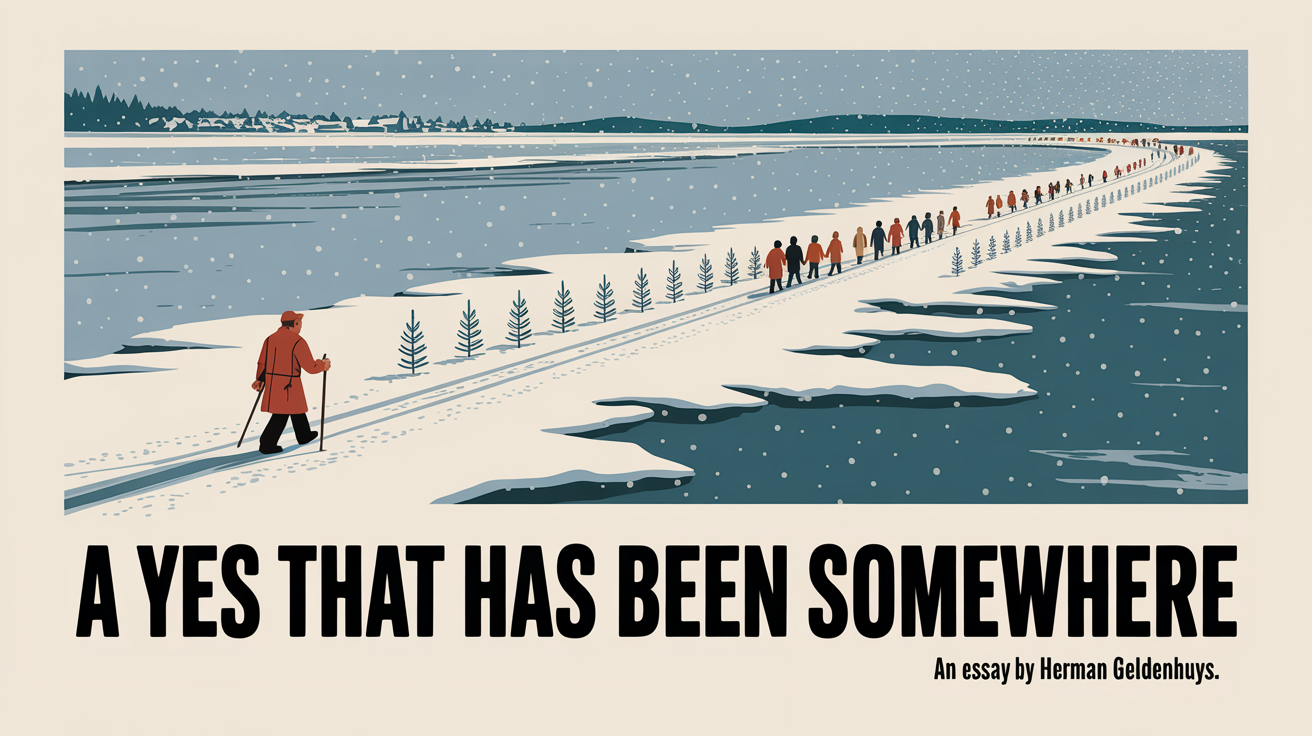
Nobody evaluates a revolution alone. When the ground shifts, professions have always done the sensible thing: they watch the people who have crossed shifting ground before. This month, the two most weathered navigators in software both spoke, and they said the same thing, calmly, and with conditions attached.
They are also the two people with arguably the most mastery to lose. That is what makes their calm worth studying. It is not bravado, and it is not naivety. It is pattern recognition, and the useful thing about pattern recognition is that it can be borrowed while our own catches up. A yes with conditions is not a smaller yes. It is a yes that has been somewhere.
The witness with the kernel
Linus Torvalds has spent more than three decades stewarding Linux, the kernel that now runs nearly everything we depend on, from phones to stock exchanges. If anyone has earned the right to guard the gates against a new tool, it is the man whose name is on the gate. Instead, he told the kernel mailing list that “Linux is not one of those anti-AI projects.” AI, he said, is “a tool, just like other tools we use, and clearly a useful one.” Kernel decisions, he insisted, rest on “technical merit, not fear of new tools.”
Notice that his welcome is not a surrender. He put an obligation on the other side of the table: the tools must “help maintainers instead of just causing them pain.” That is not a man swept along by a fashion. That is a craftsman inspecting a new blade before letting it near the good wood.
And there is a lovely symmetry in the timing. The same month, an AI system reportedly found a fifteen-year-old vulnerability in the kernel, a flaw that had sat in plain sight for a decade and a half because no human had the bandwidth to see it. The man who taught us that “given enough eyeballs, all bugs are shallow” finally, after thirty years, has enough eyeballs. His famous law did not break; it compounded.
The witness with the books
Robert C. Martin has been programming since 1964. The architecture books that carry his name formed a generation of us; some of us can still recite the principles the way others recite catechism. His observation about this moment, offered in a recent long conversation, is the calmest sentence in the whole debate: the design rules “have not changed in forty or fifty years.”
His deeper point is historical. Software has always been a rising tide, and we have always climbed it the same way: by letting go of the layer below. We let go of binary and trusted the assembler. We let go of assembly and trusted the compiler. Each time, the people who had mastered the lower layer watched the water climb a dock they had built with their own hands, and each time they carried the craft up a level and kept building. His conclusion is delivered without drama: “we are going to have to walk away from the code.”
But here is what makes his yes trustworthy: it comes with conditions. He audits structure rather than lines. He wires his agents to measurable quality tools so that discipline is enforced by instruments, not by mood. He states plainly that agents have no design sense yet; the taste still has to come from somewhere, and that somewhere is us. And he wants newcomers formed in the code before they are handed the shortcut, because, as he puts it, “agents are power tools, and young people with power tools tend to lose fingers.”
The oldest way across
Follow the leader sounds, at first, like a schoolyard taunt. It is actually the oldest and most respectable way humans cross uncertainty. In Quebec, before the bridges, people crossed the frozen St. Lawrence on ice roads marked with small evergreens planted in the ice, and the sensible traveller did not test the ice with his own boots. He crossed where the old-timers crossed, because their route was not luck; it was forty winters of reading the river.
These two guides got us this far. One of them built the road nearly everything runs on. The other wrote the maps a generation navigated by. Trusting their judgment now is not outsourcing our thinking; it is what reasonable people have always done while their own judgment catches up. Experience is not a catalogue of old answers; it is a trained sense for which ice holds. Astonishment is what inexperience sounds like. Conditions are what experience sounds like.
And the elders were not born calm. Each of them stood at a first tide once, watching a hard-won layer slide under the water. What they carried forward from that crossing was not the cold. It was the conditions.
Trust with handrails
If we want proof that the conditions travel, there is the Bun team’s reported feat this summer: a port of roughly a million lines of code in eleven days. What is instructive is not the speed but the shape of the discipline. They did not abandon rigor; they industrialized it. A written specification held the intent. Two adversarial reviewer agents contested every change. A test suite of around a million assertions held the meaning steady while the code moved underneath it. And at the end of all that machinery stood a human being, deciding whether to press merge. Eleven days was not the reward for trusting the machines. It was the reward for building a structure in which the machines could be safely distrusted at scale.
Borrowing the calm
So here is the invitation. Confidence, like courage, has always been borrowable, and the people we would borrow it from have never been better qualified. Borrow the calm; keep the conditions. Audit structure. Instrument quality. Form the young in the fundamentals before handing them the power tools. And whatever hesitation any of us carry onto the ice, let it stand for what it truly is: not a verdict on our future, but a receipt for our effort. Everything we learned the hard way is exactly what the fine print is made of.
The tide is real. But we come from people who learned to read rivers, and the old-timers are already on the ice, waving us toward the marked road. So pick one small crossing this week, and make it with their conditions in hand: tests first, structure audited, judgment kept. What follows is not a leap. It is a walk, in good company, on marked ground.