Why Faster AI Doesn't Make Faster Companies
AI got an order of magnitude faster. Your company got two or three times faster. The gap is not a mystery. It is a measurement problem.
The models got an order of magnitude faster. Your company got two or three times faster. The gap is not a mystery, and it is not the AI’s fault.
Speed is a property of the whole system. Always was. We have been measuring it in the wrong place.
The Pit Stop
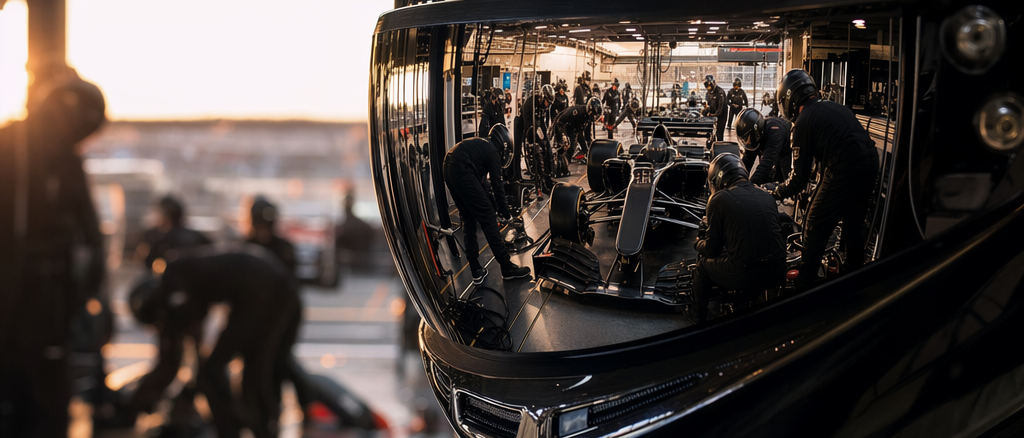
A faster engine does not win you the race if your pit stops are slow. The car is one part of the system. The choreography around the car is the rest. Lap time is necessary. It is not sufficient.
Most companies have spent the last two years building a faster engine. Code generation that used to take an hour now takes minutes. Document drafts that took a day now take a coffee break. Research that took a week now happens overnight. Each of these is real, and each of them is also the wrong place to look for company-wide speed.
The work an AI assistant replaced was, in most cases, already the fast part. Typing was never the bottleneck. Drafting was never the bottleneck. The bottleneck was always somewhere else: in the meeting where the work was specified, in the review queue where it waited for someone to look at it, in the deploy that needed three approvals from three time zones, in the escalation that had to wait for Tuesday’s leadership sync.
Those parts are still entirely human. They run at human speed. They run on human calendars. And throughput, as anyone who has ever built anything industrial will tell you, is determined by the slowest step.
The Three-Day Floor
Imagine a coding workflow that used to look like this. Spec, three hours. Implementation, eight hours. Code review, three days. Deploy, four hours. Total: about four days.
Now imagine AI compresses implementation from eight hours to twenty minutes. Astonishing. A category change. The new total: three days, four hours, twenty minutes. The savings are real and they are also rounding error against the three-day review floor.
This is the pattern that keeps showing up across every domain we touch with AI. The model is fast. The work that produced the model’s input is slow. The work that consumes the model’s output is slow. We celebrate the model’s speed because that is the visible part. The invisible parts go on running at the same calendar pace they always did.
Anyone who watched F1: The Movie last summer saw this play out in two hours. APXGP had a fast enough car. They had a champion driver. And every time they pitted, they handed back what they had gained on the track. The car was not the problem. The choreography around the car was. The film ends when the team finally fixes their pit stops, not when they fix the car. That is the lesson. The fast part was always fast enough. The slow part was always going to be the slow part.
What Moved an Inch
Here is the second uncomfortable truth. The bottleneck did not disappear. It moved one inch. And that move can feel like a transformation if we are looking only at the activity AI replaced, while it can feel like nothing at all if we are looking at customer-visible outcomes.
Engineers feel the change because their personal cycle time changed. Customers do not feel it because the company’s cycle time barely budged. Both perceptions are correct. They are looking at different parts of the same system.
This is where so much of the current debate about AI productivity goes sideways. The studies that get cited measure individual task speed and report enormous gains. The reports executives compile measure organizational throughput and report modest ones. The numbers are not in conflict. The system has many bottlenecks, and AI moved exactly one of them.
The gap between model capability and organizational benefit is not closing on its own. It is structural. Mila has a continuing education program for public-sector leaders called “AI Advantage: Productivity in Public Service.” The fact that such a program needs to exist, and needs to be taught, is the point. Without changing the rest of the system, the model’s speed has nowhere to flow.
The Measurement Problem
If you want to know whether AI is actually making your company faster, stop counting tokens. Stop tracking the percentage of code that came from a model. Stop measuring “AI adoption.” None of those numbers tell you what you need to know.
Measure end-to-end cycle time. From when an idea enters the system to when a customer feels the result. Compare it now to a year ago. That is the only measurement that matters.
If end-to-end cycle time has not improved much, the model’s gains are being absorbed by the surrounding system. Look for the new bottleneck. It is probably review, integration, alignment, or a handoff that is now exposed because everything around it sped up. The bottleneck moved. Your job is to follow it.
Following the Bottleneck
Three places to look first.
Review queues. When code or documents arrive ten times faster, the people reviewing them are still reviewing at the same pace. The queue grows. The wait grows. The model’s speed compounds in the wrong direction. Either review needs more capacity, more parallelism, or more delegation to AI itself. Doing nothing means the queue eats the gain.
Decision cadence. Most companies make important decisions at a weekly or monthly cadence: planning meetings, reviews, sync-ups. When work moves at machine speed, weekly cadences become the floor. Either decision-making moves faster, or work waits for it. There is no middle option.
Integration friction. AI produces more output, but the system that integrates that output (CI/CD, deploy gates, environment promotion) was sized for human throughput. The pipeline becomes the new bottleneck almost overnight. The work to fix this is unglamorous and does not produce a demo. It produces a faster company.
The Real Lesson
We were promised that AI would make everything faster. AI did its part. It made the part it touched faster, sometimes dramatically. The rest of the company did not.
This is not an indictment of AI. It is a reminder of how throughput actually works. Speed is never a property of the fastest part. It is always a property of the slowest. And the slowest parts of most companies were not, and never will be, the parts AI replaced.
If we want our companies to actually get faster, we have to stop celebrating lap times and start counting the seconds in the pit lane.
The next bottleneck in your company is probably the one you were proud of yesterday for not being a bottleneck. That is what makes it hard to see.