WritingEssay
The Moat Was the Paperwork
Stripe paid a reported $7.5 billion for OpenRouter and told investors the singularity began on January 1st. The real story is quieter: the cost of starting a serious company is collapsing, and the moat was never what we thought it was.
On this page
OpeningThe cheque confessesThe fence nobody understoodKeeping the awe honestBoth chairs, Monday morningWe have always told a flattering story about why big companies stay big. We said they earned it: better products, deeper expertise, the accumulated trust of customers who had been burned before and learned to prefer the safe name. It is a comforting story, because it makes bigness sound like virtue. But it was never quite the whole of the truth. What kept most incumbents safe was not that they were so very good. It was that starting anything to rival them was so very hard.
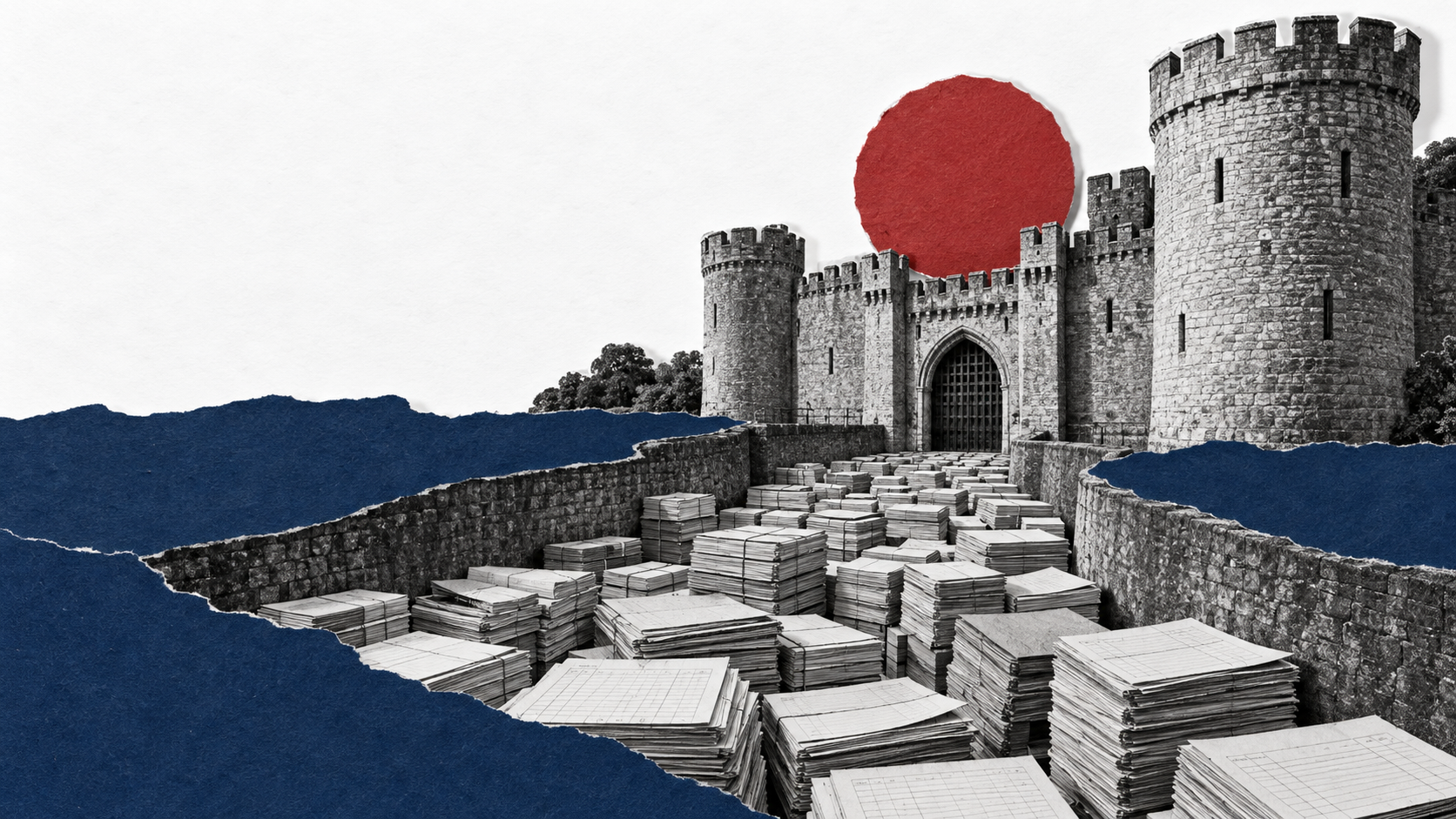
Consider what it once took to become a competitor. We incorporated. We hired someone to tell us how to incorporate. We coaxed vendors who would not return the calls of a company they had never heard of, and stitched together the billing and payroll and compliance a larger rival already had running. None of it made the product better. All of it made the product possible. The moat around the castle was not the castle’s excellence. It was the sheer, grinding cost of building a second castle at all.
And the moat did not only protect. It excluded. Most of us have carried an idea folded up small: the operations manager who could redraw her supply chain on a napkin, the engineer with a notebook of fixes nobody upstairs will fund. The idea was rarely the hard part. The apparatus was.
Which is why the most interesting forecast of the year is not an argument. It is a purchase order. Markets talk, but money confesses.
The cheque confesses
On the nineteenth of August, Stripe announced it would acquire OpenRouter, the largest acquisition in its history, at a reported seven and a half billion dollars. OpenRouter had raised money in May at a valuation of about one and a third billion. That is roughly five times the price in about three months, and a five-fold markup in a quarter is not an opinion about the future. It is a man reaching for his wallet before the number moves again.
The number matters less than who is spending it. Stripe sells no GPUs. It trains no frontier models. It needs no boom to justify a data centre. When the merchant who sells picks and shovels starts buying land, we are entitled to believe there is something in the river.
And it has been candid about what it sees. In its letter to investors: “It’s a fuzzy and perhaps already overworked term, but we decided that January 1st marked the beginning of the singularity, and we have since been operating on that basis.” The word may be too grand; the claim underneath it is concrete. Two things now flow through the digital economy, capital and intelligence, and Stripe intends to be the pipe for both.
The evidence it showed was oddly domestic. At its spring conference, Patrick Collison put up a chart of new business formation on Stripe. It turned nearly vertical in early 2026; he joked that it looked like a promotional poster for the NHL. New firm creation had roughly doubled year over year; the previous record, set during the pandemic, was about fifty percent. Then a second chart, quieter and stranger: a command line interface built seven years ago and barely touched since had suddenly caught fire. Not because more humans found it: coding agents did. A door built for a person at a keyboard turned out to be a door that software could walk through on its own.
The fence nobody understood
There is an old parable about a fence across a road. The reformer says, “I see no use in this; let us clear it away.” The wiser voice answers, “If you do not see its use, I will not let you clear it. Go and find out.” For years we treated the fence of incorporation and integration and vendor paperwork as pointless complexity that slowed honest work down. It turns out the fence was the moat. And someone has now started selling ladders.
The ladder has been under assembly for a while. Metronome for metering, Bridge for stablecoins, Privy for wallets, fraud tools extended to tokens and inference, an agentic commerce protocol co-authored with OpenAI, and Stripe Projects, where an agent can provision hosting, a database, credentials and billing from a command line. Each purchase looked, in isolation, like a bolt-on. Seen together, they read like sentences in a single paragraph, and OpenRouter is the full stop. The paragraph says: a company can now be conceived, provisioned, funded and paid, by software, for software. Automated traffic passed human traffic on the open web last year, by one measure. The customer of the near future may not have hands.
Why do incumbents so rarely build the ladder themselves? Seldom because they cannot. Thibault Sottiaux, who leads Codex at OpenAI and came from Google DeepMind, offers the plainest account. DeepMind, he says, had a working chat product roughly a year before ChatGPT and was too nervous to ship it. He describes OpenAI’s culture, by contrast, as having “very little stop energy.” Incumbents are seldom out-invented. They are out-permitted. The rival did not have the better idea. It had fewer people whose job was to say no.
Quebec understands both halves of this. The province has built one of the densest concentrations of machine intelligence talent on the continent while keeping the unglamorous virtue of the small shop; the owner of a dépanneur on the Plateau does not convene a committee before trying the next thing. The researcher’s depth and the shopkeeper’s permission live in the same city, and that is a rarer pairing than it sounds.
Keeping the awe honest
Some analysts read the deal as Stripe buying leverage over the frontier labs rather than “the singularity,” and that is fair. Within weeks of the first reports, half a dozen competitors shipped routing alternatives, and a router owned by a payments giant will spend years proving it stays neutral. The merchant buying land has told us something real about the gold; he has not told us he will still own the mine in ten years. A purchase order is evidence of belief, not proof of the future.
And there is a paradox in the fine print that should comfort us rather than deflate us: as the machinery got cheaper, the human things got dearer. Judgment, taste and trust did not lose value; they gained it, precisely because everything around them fell to nearly nothing. Someone still has to supply the problem worth solving. Nobody sells that.
Both chairs, Monday morning
If even half of this holds, there is work for both chairs, none of it despairing. For those of us running established companies, it is a handful of good questions to ask over coffee. Where does our price protect our structure rather than our value: what do customers pay us for that a well-made agent could now assemble for a fraction? Can an agent, acting for a customer, discover us, understand what we sell, and buy it without a human stepping in on our side?
For those of us on the far bank, the invitation is smaller and better. The moat stops being a wall and becomes, of all things, a bridge. Pick one workflow we know is broken, in an industry we know in our bones. Do not incorporate a movement; do not raise a round. Rent the parts, wire up the smallest honest version of the fix, and put it in front of one person with the same problem. The paperwork is being cleared away, and it was never where our worth lived. The idea was always ours. What is thinner this year is every excuse for leaving it folded in our pockets.
Written by Herman Geldenhuys in Montreal.
Keep reading
Standard Gauge
A company is sovereign in AI when it owns the seams between its work and the model: its data, its test of good work, its agents’ memory and the interface. This year showed what renting them costs, and the first seam takes one evening to reclaim.
Slow Down, Says the Car in Front
The frontier labs asked to be slowed down and their biggest rivals agreed within hours. Read what they agreed to: a slowdown capped at the size of their lead, and a lead defended by rule.

Name the Hour
Three quarters of Quebec firms cannot say which problem AI would solve for them, and Statistics Canada finds that adopting AI on its own does nothing measurable. Both facts point the same way: the first step is not a tool. It is a sentence.