WritingEssay
The Pin Factory and the Poem
The moment machine intelligence became scarce and metered, our industry began rebuilding the division of labour it thought it had transcended. Adam Smith’s pin factory explains the new agent economy, and his forgotten fine print explains where it has to stop.
On this page
OpeningThe Genius and the Shop FloorPins and PoemsThe Fine Print of 1776The Factory Turns FractalThe Canadian ColumnWhat Stays WholeThe Genius and the Shop Floor
We hired a genius and discovered we wanted a shop floor. For three years the marvel of our industry was one mind that could do everything: the code and the contract, the brief and the apology, an entire business held in a single window. Then the mind became scarce and metered, and something quietly comical happened. We began rebuilding, piece by piece and at every scale, the very institution we had congratulated ourselves on abolishing: the division of labour.
It is tempting to call this a retreat. It is nothing of the sort. It is the oldest advance we know, taken this time with our eyes half shut. The division of labour has always kept a ledger with two columns, and we only ever quote one. Specialization multiplies output: that is the column that goes on slides. Coordination is a tax: that is the column that arrives with the invoice. So the craft of the next decade comes down to a single discernment: which of our jobs are pins, and which are poems.
Pins and Poems
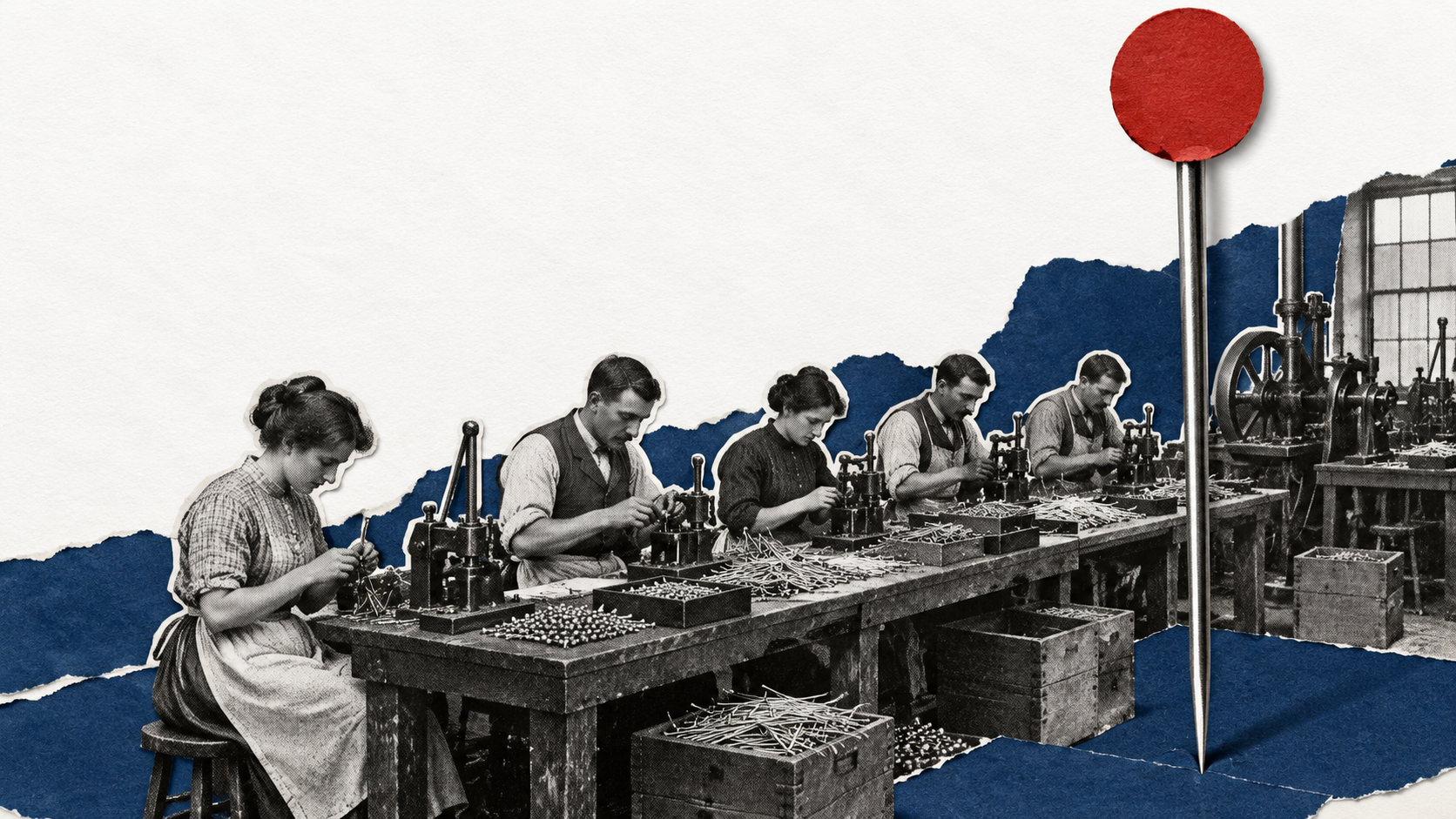
Division of labour is not a discount. It is a bet, and the thing it bets on is not the talent of the specialists but the seams of the work. A pin is work with clean seams: cut the wire, straighten it, sharpen it, grind the head, eighteen operations, each indifferent to the rest, each done best by someone who does nothing else. A poem is the opposite creature. Hand the second stanza to a different writer and you get a worse poem; the meaning lives in the whole, and every seam cut through it leaks meaning.
Anthropic’s engineers met exactly this law when they set teams of AI agents on real work. Split a task with clean seams across context-isolated specialists and the bill drops. Split a task whose meaning lives in the whole and the agents play telephone: each specialist polishes its fragment in confident ignorance of the rest, and the committee costs several times what the soloist would have, for work nobody would sign. The workers became silicon and the work did not notice. Pins are pins; poems are poems.
The Fine Print of 1776
Adam Smith opened The Wealth of Nations not with gold or markets but with a pin. Ten workers, dividing the trade into about eighteen distinct operations, could turn out some forty-eight thousand pins in a day; one alone might not manage twenty. It is the most persuasive arithmetic in economics, which is presumably why we remember it and forget the rest of the book.
For Smith attached two pieces of fine print. The first: the division of labour is limited by the extent of the market; a village cannot keep a pin factory busy. The modern translation is plain enough: a specialist agent for a task we run twice a month is a full-time employee hired for a part-time job. The second sits in Book V, where Smith warns that a lifetime spent on a few simple operations wears away the habit of large understanding, and that a society must spend deliberately to keep its people whole. The father of specialization was also its first critic. The old books have the unsettling habit of being right in both directions at once.
The Factory Turns Fractal
What Smith could not have guessed is that the pin factory would one day move inside the worker. The largest open-weight model wakes only sixteen of its 896 internal experts per token: a shop floor behind the eyes, staffed by specialists who mostly stand idle. The pattern then steps outward to teams of agents, and outward again to a young market of small domain models trained for claims, contracts, code review. Division of labour all the way down, and all the way up.
The economics explain the hurry. Token prices have reportedly fallen by something like ninety-four percent since early 2023, while usage-weighted spending nearly doubled into a May peak: cheaper units, and vastly more of them. We priced the token and forgot to price the thinking. The only honest metric is cost per completed task, and by that metric a cheap token that completes nothing is the most expensive thing we can buy.
Hence the specialists. The gap between the cheapest useful model and the frontier is estimated at roughly a hundred and eighty fold, and nobody retains a notary to lick the stamps. Enterprises running a coordinator over specialist agents report costs about a third lower, and one analyst house expects forty percent of enterprise applications to embed agents by the end of 2026. But the other column is just as loud: badly seamed multi-agent work runs four to seven times the soloist’s bill, by Anthropic’s own accounting. Smith’s first footnote arrived on schedule.
The Canadian Column
I argued recently that the first software able to sell out has begun charging like talent; the sequel is that we now staff around it the way we staff around talent, and for Canada that is unexpectedly good news.
Here is the pleasant inversion for those of us who fund and serve Canadian entrepreneurs. The firms furthest behind in adoption, roughly one in eight small businesses today with six in ten expected by 2034, are precisely the firms richest in pin-shaped work: claims triage, dispatch, intake, the paperwork stacked behind a Saint-Laurent storefront. They were never waiting for a genius. They were waiting for three reliable specialists. And for the first time the two halves of Smith’s condition meet: the extent of our market is finally large enough to support the specialists, and the specialists are finally small enough to fit the market. A small owned model, tuned to one job and kept at home under Quebec’s data-residency rules, beats a rented genius on cost, on privacy, and on the quiet dignity of not routing the shop’s every thought through someone else’s meter.
The discipline that follows fits in one question. Take any workflow and ask: if the middle of this job were handed to a stranger, would the result survive? If yes, it is a pin: decompose it, give each operation to the smallest specialist that does it well, and bank the spread. If no, it is a poem: keep it whole, give it to one mind, human or frontier, and pay the soloist’s rate gladly, because the committee will cost more and deliver less. A specialist is cheap to run and expensive to trust, so write the coordination tax into the plan before the invoice writes it in for us.
What Stays Whole
And we should say plainly which jobs are poems, because they are the hopeful part. Strategy is a poem. Taste is a poem. The essay a founder writes at midnight, the pitch that makes a room lean forward, the call on which market to enter: these get worse with every seam, and no factory at any scale will change that. Smith’s old warning is answered not by refusing the factory but by keeping the poems for ourselves, and the delight of this decade is that the factory keeps handing them back.
The first industrial revolution took two centuries to learn its own fine print. We get to run it again in five years, ledger open to both columns from the start. There is plenty to do, and it starts this quarter: walk the workflows and sort the pins from the poems. The pins will look after themselves. The poems are ours to write.
Written by Herman Geldenhuys in Montreal.
Keep reading
Standard Gauge
A company is sovereign in AI when it owns the seams between its work and the model: its data, its test of good work, its agents’ memory and the interface. This year showed what renting them costs, and the first seam takes one evening to reclaim.
Slow Down, Says the Car in Front
The frontier labs asked to be slowed down and their biggest rivals agreed within hours. Read what they agreed to: a slowdown capped at the size of their lead, and a lead defended by rule.
Rent the Frontier, Own the Workhorse
The strangest chart in AI shows usage flooding toward cheap open models while the money concentrates at the frontier. It is not a paradox: intelligence is two purchases wearing one name, and only one of them compounds.