WritingEssay
The Four-Minute Mile
In one October week, AI mathematics left one camp furious and another throwing a party. The best news came from neither: within hours of a machine nudging an old limit, people were building on it, some with machines of their own.
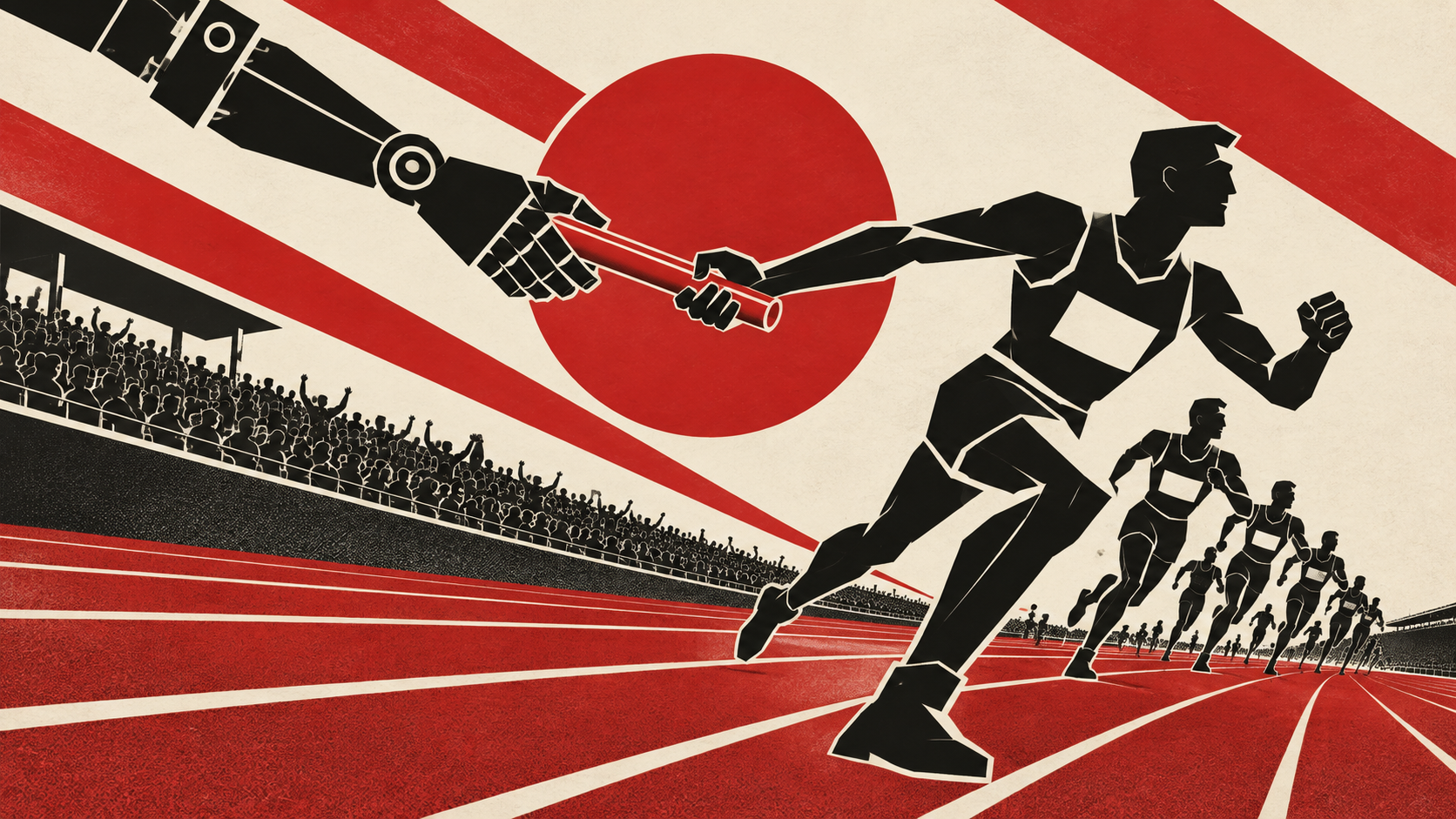
When a machine moves a limit we thought was fixed, the outrage is real and so is the fear, but neither is the whole story. The best part is what people do the next morning. This month, in mathematics, they started running.
On 6 October OpenAI released 722 machine-written mathematics papers1 in one go, grouped into 372 families, from roughly 4,000 problems posed to an unreleased model. Three were withdrawn the next day over a sign error, which is its own small lesson in speed. OpenAI’s page explains why it went looking for open problems at all: it expanded its tests “after performance on our existing mathematical evaluations saturated.” In plain words, the old exams had become too easy.
Two videos captured how far apart the reactions were. Two days after the release, ColdFusion, a popular science channel, looked back at OpenAI’s September claim about the equations of fluid flow and described the mood among mathematicians: “the general sentiment seemed to be anger.” Three days after that, AI Search called the October release “the biggest day in the history of mathematics.” One company’s work, and two rooms that could barely hear each other.
Both rooms have a point. In September, 25 Fields Medallists launched a declaration2, with 28 signed by now, warning that “the goals of the AI companies and the goals of the mathematical community are severely misaligned.” Read it closely, though, and the angry letter opens with a concession most cheerleaders would envy: the models have improved “to the point that they can solve major outstanding problems in many fields of mathematics.” Their worry is whether a solved problem still adds to understanding, and who gets credit for the ideas behind it. That is a serious worry. It is also a long way from “the machines can’t do it”. We have moved from “can it?” to “now what?”, which is a far more interesting question to live inside.
Iffley Road
On 6 May 1954, on a cinder track at Oxford, Roger Bannister ran a mile in 3 minutes 59.4 seconds. Forty-six days later John Landy ran it faster in Finland. The legend makes four minutes a wall of the body, and Bannister the man who sent a flood of runners through it. The legend is mostly wrong, which is the most useful thing about it. The running coach Steve Magness3 counted: ten men under four minutes within two and a half years, a steady improvement rather than a dam bursting. The record had stood since 1945 while the sport itself was changing.
What Bannister broke was a number people had begun to treat as a limit. Once a limit is beaten in public, nobody can treat it as one again. The first week of October gave mathematics its own version.
Among OpenAI’s papers was a claim about one of the oldest questions in computing: how fast can a computer multiply two very large numbers? Since 1971 the working belief had been that the theoretical floor was n log n steps. The model claimed to lower the power on that log n by a sliver, one part in 2 to the power 182. It is a theoretical bound, not a stopwatch, and the claim has not yet been reviewed.
Four and a half hours after OpenAI’s repository appeared, Douglas Colkitt published his own4, building on the claim and making that sliver roughly 2 to the power 75 times larger. By the next evening he had improved it twice more. Others joined. A snapshot on 13 October showed 407 commits under at least 25 author names, and the bound had moved further than the machine’s first step by a margin no headline could fit. Some of those commits credit the AI tools their authors worked with. Every one of those stronger bounds rests on the original proof, so the referees still have the last word. What we can celebrate already is the speed at which people found new ideas worth testing.
Too much food
Terence Tao5, one of the most respected mathematicians alive, put the new problem in a cook’s terms in a video published in September: “we’re now experiencing what you might call proof indigestion.” Results arrive faster than anyone can read them. Then he turned the worry into a feast: “It’s a good problem to have … more food than you can eat than not enough food to eat. But it is still a problem.”
He also reported something better than abundance. After a model disproved an old conjecture about distances between points this spring, nearby problems “have now also been solved by humans who have adapted the AI’s technique. I found that quite exciting.” The machine offered a method, and people found more to do with it.
Andrew Granville at the Université de Montréal explained the reason in 2023. Writing about proof in the time of machines6, he noted that human readers of a proof do more than check it; they “can adapt the learned ideas to other questions.” Tao’s example is that old habit at work on new material, and the Colkitt repository is the same habit at GitHub speed.
Who runs next
The physicist Jonathan Gorard noticed, cautiously and among his own colleagues, that the earliest adopters of these tools were the youngest graduate students and the most senior researchers, while the people in the middle of their careers were the most likely to shun them. He called it a weak pattern, and it is still worth asking where our own reputations make a useful tool harder to try.
So here is the invitation. This week, let’s hand a machine the problem in our work that everyone treats as fixed, the report that always takes a week or the analysis nobody attempts. Then let’s check what comes back against the records, and build on whatever holds before lunch.
Written by Herman Geldenhuys in Montreal.
Sources
- GitHub, 722 machine-written mathematics papers
- mathandai.org, a declaration
- scienceofrunning.com, The running coach Steve Magness
- GitHub, Douglas Colkitt published his own
- YouTube, Terence Tao
- arXiv, proof in the time of machines
Keep reading
Depth Is a Disagreement
When an AI recommendation came with a generated justification, evaluators followed it more readily. Bessel’s 1838 star measurement offers the way out: a second view, taken from somewhere else. For AI work that means a second model from a different family, and keeping the two views far enough apart to disagree.
Standard Gauge
A company is sovereign in AI when it owns the seams between its work and the model: its data, its test of good work, its agents’ memory and the interface. This year showed what renting them costs, and the first seam takes one evening to reclaim.
Slow Down, Says the Car in Front
The frontier labs asked to be slowed down and their biggest rivals agreed within hours. Read what they agreed to: a slowdown capped at the size of their lead, and a lead defended by rule.